

A Comprehensive Guide to Comparing Lab Grown Diamonds
Why Lab-Grown Diamonds Are Revolutionizing the Jewelry Industry
Lab grown diamonds are real diamonds created in controlled labs using technology that mimics the natural diamond formation process. Also known as cultured diamonds, they share identical physical, chemical, and optical properties with mined diamonds but cost 30-60% less and offer a more ethical alternative.
Quick Facts About Lab-Grown Diamonds:
- Composition: Pure carbon atoms arranged in the same crystal structure as natural diamonds
- Hardness: Rank 10 on the Mohs Scale - identical to mined diamonds
- Cost: 30-60% less expensive than natural diamonds of comparable quality
- Creation Time: Weeks to months (vs. billions of years for natural diamonds)
- Certification: Graded by the same institutions (GIA, IGI) using the 4Cs
- Durability: Last forever and never fade, cloud, or discolor over time
The rising popularity of lab-grown diamonds reflects a shift toward conscious consumerism, with modern couples valuing transparency, ethical sourcing, and greater value. Unlike simulants like cubic zirconia or moissanite, lab-grown diamonds are real diamonds with the same coveted sparkle, fire, and brilliance.
Even trained gemologists cannot distinguish between lab-grown and natural diamonds with the naked eye; only specialized equipment can. The Federal Trade Commission (FTC) has even updated its official definition of a diamond to reflect this, removing the word "natural."
For those seeking an engagement ring or other fine jewelry, lab-grown diamonds offer a perfect blend of beauty, value, and peace of mind.
The Science Behind the Sparkle: How Lab-Grown Diamonds Are Made
Have you ever wondered how a diamond can be created in a lab? It’s a remarkable feat of advanced technology. Lab grown diamonds are a "miracle of modern technology" because they perfectly replicate the conditions under which natural diamonds form deep within the Earth.
The journey to create diamonds in a lab has a fascinating history. Scientists have been attempting to synthesize diamonds since the 19th century, but reproducible, gem-quality diamond synthesis only became a widespread reality much more recently. You can find out more about their origins in our guide, When Did Lab-Grown Diamonds Start?.
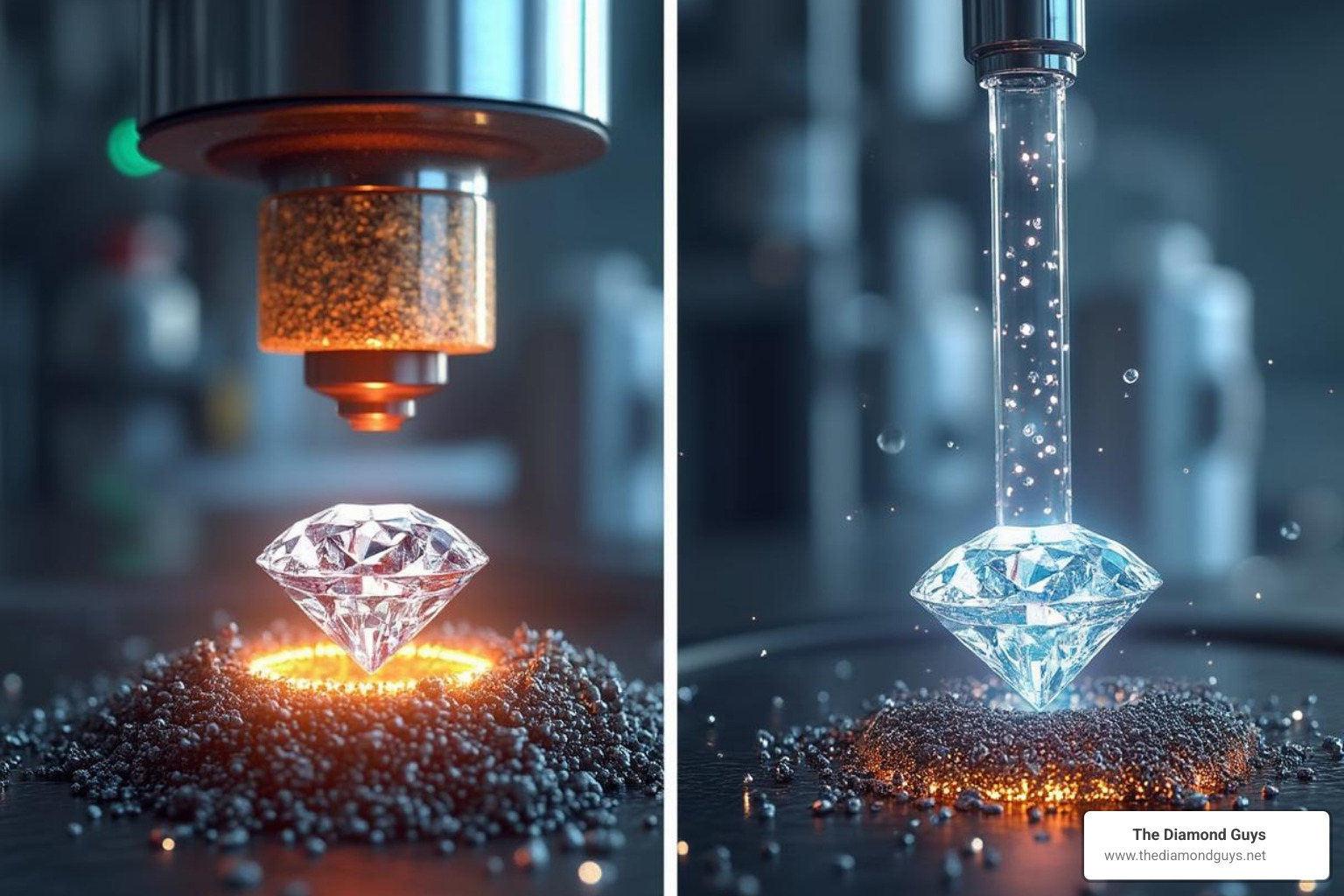
Today, gem-quality lab grown diamonds are created using two sophisticated methods: High-Pressure, High-Temperature (HPHT) and Chemical Vapor Deposition (CVD). Both processes start with a tiny "diamond seed"—a sliver of an existing diamond—and build upon it, atom by atom, to form a new, larger diamond crystal.
High-Pressure, High-Temperature (HPHT)
The HPHT method recreates the intense conditions deep within the Earth's mantle where natural diamonds form, but on an accelerated timeline.
Here’s how it works:
A small diamond seed is placed in a growth chamber with a carbon source (like graphite) and a molten metal flux, which acts as a solvent. The chamber is then subjected to immense high pressure (around 5-6 GPa) and intense high temperature (1300-1600°C).
Under these conditions, the carbon dissolves and crystallizes around the diamond seed, forming a new, larger diamond. This diamond growth process takes several days to weeks, depending on the desired size and quality.
Chemical Vapor Deposition (CVD)
The CVD method uses a different approach, operating at lower pressures and more moderate temperatures than HPHT.
Here’s the breakdown:
A diamond seed is placed in a vacuum chamber, which is then filled with carbon-rich gases like methane. Microwave energy ionizes the gases into a plasma, breaking down the gas molecules.
Finally, individual carbon atoms from the plasma deposit onto the diamond seed, crystallizing layer by layer. This precise atom-by-atom growth takes several weeks. The resulting lab grown diamond is chemically and structurally identical to a natural one, though sometimes a post-growth HPHT treatment is used to improve color. Both HPHT and CVD methods produce real diamonds, allowing us at The Diamond Guys to offer beautiful, ethical, and more affordable options for your jewelry needs.
Lab-Grown vs. Natural Diamonds: A Head-to-Head Comparison
How do lab grown diamonds stack up against natural ones? The truth might surprise you. While there are key differences in their origin and value, their similarities are what's truly stunning. For a deeper dive, check out our guide on Lab Diamonds vs. Real Diamonds.
Lab grown diamonds are chemically, physically, and optically identical to diamonds from the earth. Both are pure carbon, arranged in the same crystal structure. This means they sparkle and show off brilliance and fire in the exact same way. To the naked eye, they are indistinguishable.
Here's a head-to-head comparison:
| Feature | Lab Grown Diamonds | Natural Diamonds |
|---|---|---|
| Origin | Created in labs over weeks to months using HPHT or CVD, replicating natural diamond-forming processes. | Formed deep within the Earth over billions of years under extreme heat and pressure, then mined. |
| Cost | Costs 30-60% less than natural diamonds of comparable quality. Accessible pricing is due to efficient, unlimited production capacity. | More expensive due to rarity, mining costs, and a historically controlled supply chain. |
| Purity | Often purer with fewer defects due to controlled growth. Many are Type IIa, a classification rare in mined diamonds. | Can contain more impurities and defects from their natural formation. Type IIa diamonds are very rare. |
| Environmental Impact | Lower environmental footprint, requiring less energy, water, and land. Produces minimal waste and emissions compared to mining. | Mining can cause significant land disruption, water pollution, and carbon emissions. |
| Ethical Sourcing | Guaranteed conflict-free with a transparent supply chain and ethical labor practices in a controlled lab environment. | Can be associated with ethical concerns like "blood diamonds" and unsafe labor. The Kimberley Process aims to prevent this but has limitations. |
| Resale Value | Resale market is still developing and value tends to depreciate. Purchased for beauty and affordability, not as a financial investment. | Historically perceived to hold value, but resale value often depreciates from retail price. Perceived rarity is a key factor. |
| Physical Properties | Identical: Mohs Hardness 10, Refractive Index 2.42, Density 3.52 g/cm³, same crystalline structure. | Identical: Mohs Hardness 10, Refractive Index 2.42, Density 3.52 g/cm³, same crystalline structure. |
| Appearance | Visually indistinguishable from natural diamonds to the naked eye. Differentiated only by specialized gemological equipment. | Visually indistinguishable from lab grown diamonds to the naked eye. Differentiated only by specialized gemological equipment. |
Are Lab-Grown Diamonds Real Diamonds?
So, are lab grown diamonds real diamonds? The answer is an emphatic yes! The Federal Trade Commission (FTC) and the scientific community agree: a diamond is defined by its composition, not its origin. A diamond is carbon crystallized in a specific structure. Whether it formed in the Earth or a lab, if it has that structure, it's a diamond.
This distinguishes them from simulants like cubic zirconia (CZ) or moissanite, which are different materials that only look like diamonds. A lab grown diamond is pure carbon, giving it the same lasting sparkle and strength as a natural one. Because it is a diamond, it will never fade, discolor, or get cloudy.
Even experienced jewelers can't tell a lab grown diamond from a natural one with the naked eye. They require high-tech equipment to detect microscopic growth patterns that reveal how it was formed. We're always upfront about this at The Diamond Guys. Curious to know more? Dive into our articles: Are Lab-Grown Diamonds Real Diamonds? and Can a Jeweler Tell the Difference Between Lab-Grown Diamonds?.
Durability and Hardness
Lab grown diamonds are just as tough as their natural counterparts, scoring a perfect 10 on the Mohs Scale of Hardness. As the hardest known material, they are exceptionally resistant to scratches, making them perfect for daily wear in any jewelry.
While incredibly hard, no diamond is unbreakable. A sharp, forceful impact can chip or break any diamond, whether lab-grown or natural. However, for everyday wear, lab grown diamonds offer the same durability and resilience as mined diamonds, ensuring they are made to last. Learn more in our article: Are Lab-Grown Diamonds as Strong as Real Diamonds?.
Grading the Brilliance: Quality and Value of Lab Grown Diamonds
Understanding quality is key when shopping for a diamond. Lab grown diamonds undergo the same rigorous grading process as mined diamonds, ensuring their brilliance. Thanks to advanced technology, they now achieve remarkable sizes and quality grades.
Recent developments in diamond synthesis have led to consistent improvements in color and clarity. For the latest insights, you can explore the Latest research on lab-grown diamonds.
The beauty of lab grown diamonds lies in their exceptional quality and value. Because they're created in controlled environments, they often have fewer impurities and structural defects than natural diamonds, giving you incredible quality for the cost.
The 4Cs of Lab Grown Diamonds
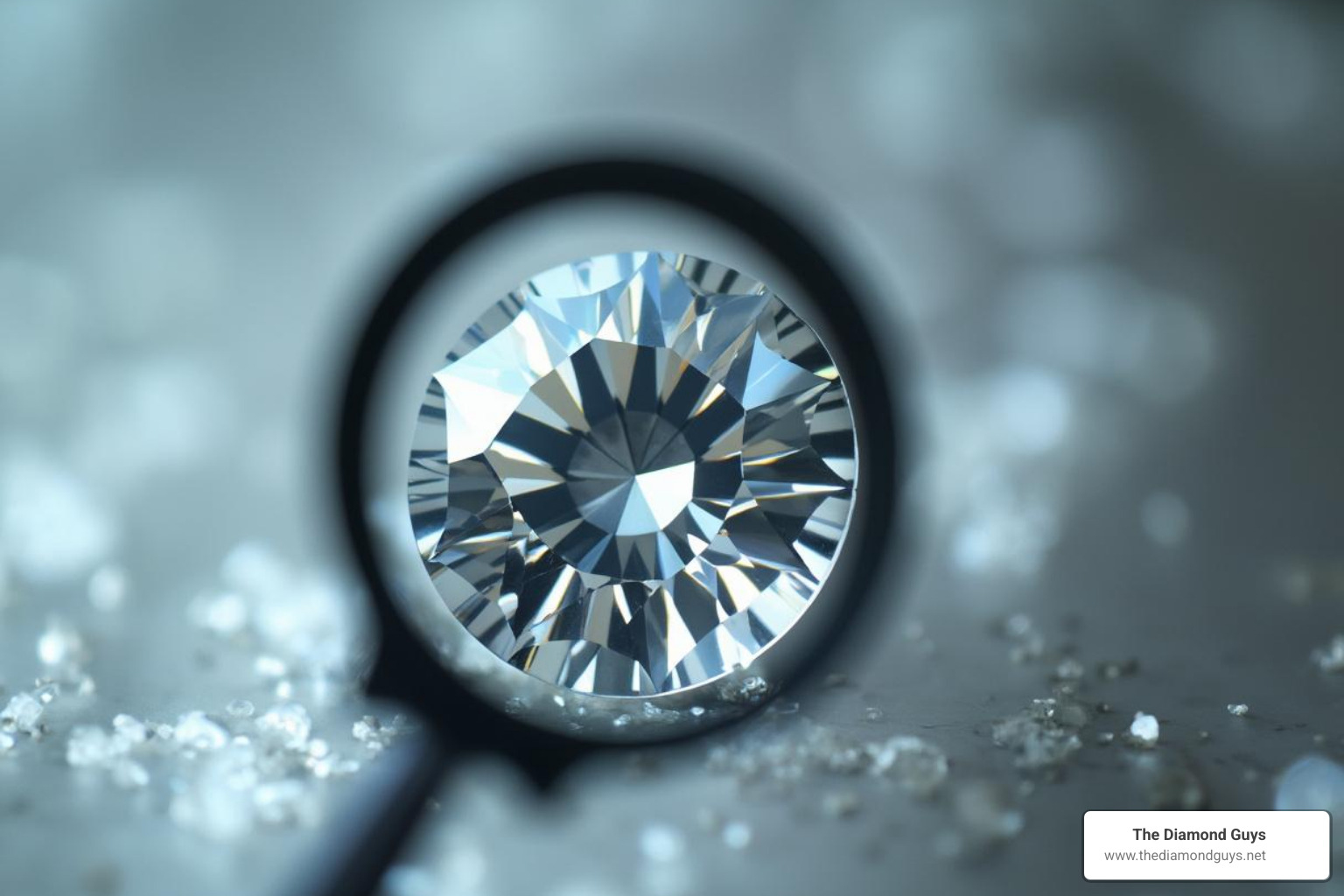
Every diamond's quality is judged by the 4Cs: Cut, Color, Clarity, and Carat Weight. These standards apply equally to lab grown diamonds and help you choose a stone with breathtaking sparkle.
Cut refers to how well a diamond's facets interact with light, not its shape. A well-cut diamond has superior brilliance (white light reflection) and fire (rainbow flashes). A poor cut can make even a high-quality diamond look dull.
Color is graded from D (colorless) to Z (light yellow/brown). The controlled process for lab grown diamonds often results in highly desirable colorless grades (D-F), giving them a crystal-clear appearance.
Clarity measures the absence of inclusions (internal flaws) and blemishes (external flaws). Lab grown diamonds often have fewer flaws because they are created in a controlled environment, making exceptional clarity more accessible.
Carat Weight is the diamond's weight (1 carat = 200 milligrams). Because lab grown diamonds are more affordable, you can often get a larger carat weight for your budget without sacrificing the other Cs.
Certifications and Standards
Trust is essential when making an important purchase. That's why lab grown diamonds are certified by the same prestigious, independent institutions that grade natural diamonds. These labs use advanced equipment to evaluate quality, ensuring your confidence.
Leading labs like GIA (Gemological Institute of America) and IGI (International Gemological Institute) provide comprehensive grading reports. These reports, which often include a laser inscription on the diamond's girdle, confirm the stone's quality and clearly state it is laboratory-grown.
These grading reports are your assurance that your lab grown diamond meets the highest standards of beauty and quality. You can also insure your lab grown diamonds just like any other valuable jewelry. Learn more about protecting your investment in our guide: Can You Insure Lab-Grown Diamonds?.
The Conscious Choice: Benefits and Future of Lab-Grown Diamonds
Choosing a lab grown diamond is both a smart financial decision and a conscious one. As consumers become more aware of their purchases' origins, the ethical and environmental benefits of lab grown diamonds are a compelling advantage. If you're considering a significant purchase, asking Should I Buy a Lab-Grown Diamond Engagement Ring? is a great first step.

Environmental and Ethical Impact
Traditional diamond mining has a large environmental footprint, involving significant land disruption, water pollution, and carbon emissions. In contrast, lab grown diamonds offer a much more sustainable alternative:
- Lower Energy Consumption: Lab-grown diamond production consumes significantly less energy per carat compared to mining.
- Minimal Land Disruption: Growing diamonds disrupts a fraction of the land required for mining.
- Reduced Pollution: The lab-growing process generates minimal pollution and mineral waste.
- Ethical Labor Practices: Labs provide safe working conditions and a transparent, conflict-free supply chain, eliminating the ethical concerns associated with "blood diamonds."
This commitment to sustainability makes lab grown diamonds a favorite among those seeking luxury without compromise.
The future for lab grown diamonds is bright. Their market share has grown dramatically, and increasing production efficiency has made them more affordable. This trend suggests a robust and expanding market as they become a mainstream choice for consumers worldwide.
Common Applications and Styles
While perfect for fine jewelry, the applications of lab grown diamonds extend much further. In jewelry, they are used in a full range of stunning pieces:
- Engagement Rings: Offering larger, higher-quality stones for any budget.
- Solitaire Rings: Showcasing the pure brilliance of a single diamond.
- Pendants: From classic solitaires to intricate designs.
- Earrings: Including studs, drops, and hoops.
- Bracelets: Such as sparkling tennis bracelets.
Beyond adornment, their unique properties make them invaluable in high-tech and industrial fields. Their hardness is ideal for cutting tools and abrasives. Their thermal conductivity is used for heat sinks in electronics, and their optical properties are perfect for high-power lasers. They also have applications in semiconductors, medical devices, and even water purification.
Frequently Asked Questions About Lab-Grown Diamonds
It's natural to have questions about something as innovative as lab grown diamonds. We're here to answer the most common inquiries to help you feel confident in your choice.
Do lab diamonds pass a diamond tester?
Yes, lab grown diamonds will pass standard diamond testers. These devices test for thermal or electrical conductivity, properties that are identical in both lab-grown and natural diamonds due to their shared chemical and physical structure. A tester identifies the material as a diamond, regardless of its origin. Only specialized gemological equipment can differentiate between them. Learn more here: Do Lab Diamonds Pass a Diamond Tester?.
Do lab-grown diamonds get cloudy?
No, lab grown diamonds do not get cloudy, fade, or lose their sparkle. Like natural diamonds, they are made of stable carbon crystals, ensuring their brilliance lasts forever. If your diamond ever looks dull, it's likely due to surface buildup from oils, lotions, or soaps. A simple cleaning with warm water, mild soap, and a soft brush will restore its shine. Get more tips here: Do Lab-Grown Diamonds Get Cloudy?.
Are lab-grown diamonds a good investment?
In the traditional financial sense, diamonds (both lab-grown and natural) are not considered investments like stocks or real estate. They are luxury goods purchased for their beauty and sentimental value.
However, lab grown diamonds offer incredible value. Their lower price point means you can get a larger, higher-quality stone for your budget. This value is a primary reason for their popularity.
The resale market for lab-grown diamonds is still developing, and they should be purchased for their personal and sentimental value rather than as a financial asset. Choose a diamond you love for its intrinsic beauty and the joy it brings.
Making the Right Choice for Your Forever
Lab grown diamonds represent a remarkable blend of technology, ethics, and beauty. They are identical to natural diamonds in every way—chemically, physically, and optically—offering the same durability and sparkle. Graded by esteemed labs like GIA and IGI, they meet the highest quality standards.
With a lower environmental impact, guaranteed conflict-free origins, and a more accessible price, lab grown diamonds are the definition of conscious luxury. They are a smart choice for those seeking maximum quality and sparkle without the ethical and environmental baggage of mined diamonds. It's about getting more of what you love, responsibly.
At The Diamond Guys, with locations in Scottsdale, AZ, and Los Angeles, CA, we're passionate about helping you find or custom-design the perfect piece. We offer expert guidance and a personalized experience, empowering you with knowledge to make a confident choice. We provide both natural and lab grown diamonds with full transparency and a commitment to your satisfaction.
We invite you to explore our collections and find the diamond that speaks to your heart. You can explore the differences between lab and real diamonds on our website, or visit us in person for a personalized experience.


