

Your Wallet's Best Friend: Decoding Lab-Grown Diamond Costs
Open uping the Value of Lab-Grown Diamonds
The synthetic diamond price offers a significant saving compared to natural diamonds. For example:
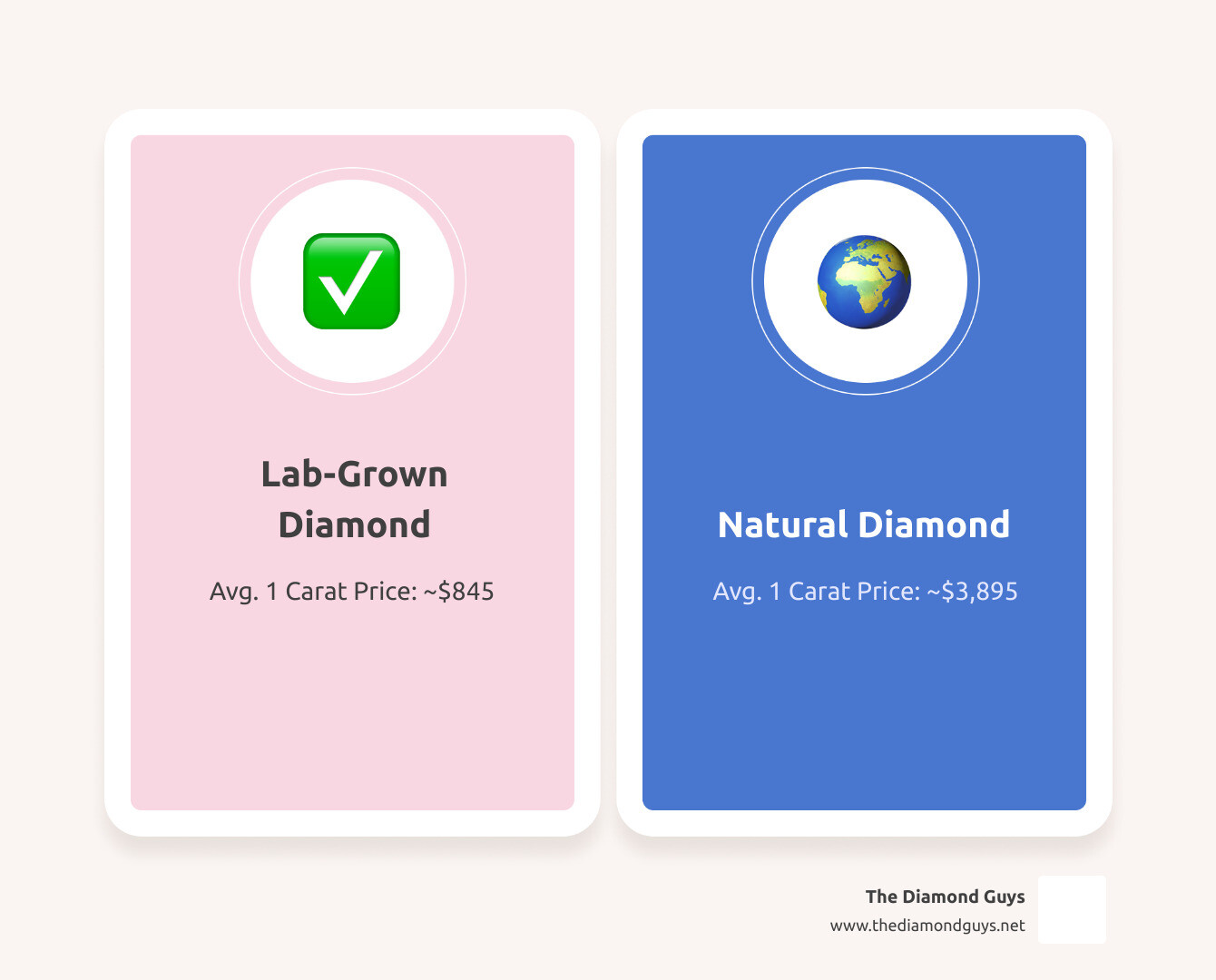
- A 1-carat lab-grown diamond costs around $845.
- A similar 1-carat natural diamond costs about $3,895 (Q1 2025 data).
This means lab-grown diamonds can be 80-95% less expensive than their mined counterparts.
Lab-grown diamonds have rapidly grown in popularity. In 2024, over half of all new engagement rings featured a lab-grown stone. It's easy to see why this trend is taking hold.
These are not "fake" diamonds. Lab-grown diamonds are chemically, physically, and optically identical to mined diamonds. They share the exact same sparkle, fire, and durability. They are, simply put, real diamonds – just grown in a controlled environment instead of deep within the earth.
This guide will help you understand the true cost of lab-grown diamonds. We'll explore what factors make their prices different and what you should look for when making a purchase. Our goal is to provide clear, honest information. We want you to feel confident in your choice, knowing you’ve found the best value for your budget.
Want to learn more about how lab-grown diamonds are real diamonds? Click here.
Lab-Grown vs. Natural: A Clear Price Advantage
Alright, let's get right to the heart of it: the incredible price difference. When we talk about the synthetic diamond price, it's usually the first thing that catches people's eye. Lab-grown diamonds can be anywhere from 80% to 95% less expensive than a natural diamond of similar quality. That's a huge saving, and it's why so many people are making the switch.
Think about it this way: for the first quarter of 2025, a beautiful, 1-carat lab-grown diamond cost around $845. Now, a similar natural diamond? That would be about $3,895. We're talking nearly five times the price for something that looks identical to the naked eye.
The savings are even more dramatic with larger stones. A 2-carat, E color, VS2 clarity natural diamond might cost $30,000, whereas a lab-grown version could be as little as $1,750. This price difference makes dream rings far more accessible.
This isn't magic; it's simply smart economics. The main reason for this price gap lies in how these diamonds come to be. Natural diamonds require massive mining operations, which are incredibly expensive and take a toll on the environment. Lab-grown diamonds, however, are crafted in controlled environments, making the process much more streamlined and efficient.
To really put it into perspective, here's a quick side-by-side comparison for that impressive 2-carat diamond:
| Feature | 2-Carat, E Color, VS2 Clarity Lab-Grown Diamond | 2-Carat, E Color, VS2 Clarity Natural Diamond |
|---|---|---|
| Average Price | Approximately $1,750 | Approximately $30,000 |
| Sourcing | Created in a laboratory | Mined from the Earth |
| Supply | Potentially unlimited | Finite, regulated |
| Resale Value | Very little to no | Retains some value (e.g., ~50% of purchase) |
As you can see, while they share the same dazzling beauty, their journey to your finger, and their market value, are quite different!
Curious to learn even more about the distinctions? Dive into our full guide: Lab Diamonds vs Real Diamonds.
Why Are Lab-Grown Diamonds So Much Cheaper?
So, why are lab-grown diamonds so much more affordable? It's a matter of supply, demand, and incredible technological progress.
First off, natural diamonds are a finite resource, formed over billions of years deep inside the Earth. Digging them out involves complex, costly, and often environmentally impactful mining operations. Plus, their supply has traditionally been tightly controlled, which helps keep prices high.
Lab-grown diamonds are created in advanced labs, giving them a virtually unlimited supply. As technology improves and more producers enter the market, competition and increased supply drive prices down. The process eliminates massive mining costs and shortens the supply chain.
A huge factor in the falling synthetic diamond price has been amazing technological advancements. Believe it or not, back in 2008, it cost about $4,000 to produce just one carat of a lab-grown diamond. Today? That cost has dramatically plummeted to around $300 to $500 per carat! This massive drop in production cost is directly passed on to you, the consumer.
Lab-grown diamonds are typically created using one of two clever methods:
- High Pressure-High Temperature (HPHT): This method basically mimics how natural diamonds form. Carbon is put under immense pressure and super high temperatures, just like deep underground.
- Chemical Vapor Deposition (CVD): Here, a tiny diamond "seed" is placed in a chamber filled with carbon-rich gases. These gases are zapped, creating a plasma, and carbon atoms then "rain down" onto the seed, slowly building up a beautiful diamond, layer by layer.
Both of these methods have become incredibly efficient, allowing for the widespread creation of gem-quality diamonds. The continuous refinement of these processes is the core reason why the synthetic diamond price has become so attractive. Want to get a bit more technical? You can learn more about how these incredible diamonds are made here.
Understanding the Synthetic Diamond Price: Key Influencing Factors
Just like a custom-custom suit, the synthetic diamond price isn't a fixed tag. It's a careful calculation based on several important features that make each diamond unique. You might have heard of the "Four Cs" – Cut, Color, Clarity, and Carat weight. These are the universal standards, whether a diamond grew deep in the earth or in a controlled lab environment. Understanding them is your secret weapon for finding the perfect stone that sparkles within your budget.
Beyond these famous Four Cs, things like the diamond's shape and the certification it comes with also play a big part in its final cost. Every diamond we offer, whether natural or lab-grown, is graded using the same rigorous standards by independent gemological labs. This ensures you know exactly what you're getting.
How the 4 Cs Impact the Synthetic Diamond Price
Let's break down each of the Four Cs and see how they influence the synthetic diamond price:
First up is Carat Weight. This refers to how much a diamond weighs. As carat weight increases, so does the price, since larger lab-grown diamonds require more resources to grow. A pro tip: choosing a diamond just shy of a full carat (e.g., 0.90 ct instead of 1.00 ct) can offer significant savings with no visible size difference to the naked eye.
Next, we have Cut Quality, and this is often the most important C for sparkle! The cut refers to how well a diamond's facets interact with light, not its shape. An excellent cut maximizes sparkle, brilliance, and fire. Even a diamond with great color and clarity can look dull if poorly cut. Lab-grown diamonds often achieve stunning cuts, and the better the cut, the higher the price due to the skill and material required.
Then there's Color Grades. In white diamonds, color refers to the absence of color, on a scale from D (colorless) to Z (light yellow/brown). While D-F grades are top-tier, G or H diamonds often appear colorless to the eye once set in a ring. Choosing a near-colorless grade can significantly lower the synthetic diamond price, allowing savings to be put towards a bigger stone or better cut.
Finally, we consider Clarity Grades. This measures how free a diamond is from tiny internal marks (inclusions) or external blemishes. The scale ranges from Flawless (FL) to Included (I3). For most engagement rings, you'll want an "eye-clean" diamond, meaning you can't see any inclusions without magnification. Grades like VS1 or VS2 (Very Slightly Included) often offer eye-clean diamonds at a much more accessible price point than the rare Flawless or Internally Flawless grades. This is another area where you can find incredible value in lab-grown diamonds.
Here's a quick look at the clarity scale:
- FL (Flawless): No inclusions or blemishes visible even under 10x magnification.
- IF (Internally Flawless): No inclusions visible under 10x magnification, just tiny external blemishes.
- VVS1, VVS2 (Very, Very Slightly Included): Inclusions are extremely difficult to see, even with 10x magnification.
- VS1, VS2 (Very Slightly Included): Inclusions are difficult to see with 10x magnification. These are often eye-clean!
- SI1, SI2 (Slightly Included): Inclusions are noticeable under 10x magnification, but many SI1s are still eye-clean.
- I1, I2, I3 (Included): Inclusions are obvious under 10x magnification and might affect the diamond's sparkle.
Understanding these details helps us guide you to the perfect diamond that truly fits your budget and desires. Curious if a lab-grown diamond is the right choice for your engagement ring? Learn more in our guide: Should I Buy a Lab-Grown Diamond Engagement Ring.
The Role of Diamond Shape and Cut
Beyond the Four Cs, the diamond's shape makes a huge difference in how it looks and feels, and yes, even its price! While "cut" is all about sparkle, "shape" is its outline – whether it's round, oval, emerald, or something else.
The Round Brilliant is still the undisputed king of diamond shapes. It's the most popular, and also typically the most expensive. Why? Because it's engineered to deliver the ultimate sparkle and fire, and creating it means a bit more of the rough diamond material is lost during the cutting process. In fact, Round diamonds made up over half of all lab-grown diamond searches in March 2025 – they're truly the benchmark!
But don't overlook "fancy shapes" (that's any shape other than round). They offer amazing variety and can often give you more bang for your buck for the same carat weight. Popular fancy shapes include:
- Emerald Cut: This shape is known for its neat, rectangular "step-cut" facets that create a unique "hall of mirrors" effect. They tend to look larger face-up than many other shapes, giving you more perceived size for your carat weight.
- Oval Cut: A timeless and elongated shape that not only often appears larger than a round diamond of the same carat weight but also has a lovely lengthening effect on the finger.
- Radiant Cut: This brilliant cut combines the sparkle of a round diamond with the neat, trimmed corners of an emerald cut. Radiant diamonds are surging in popularity thanks to their incredible sparkle and distinctive look.
- Cushion Cut: With its soft, rounded corners and brilliant faceting, the cushion cut offers a romantic, vintage feel. It can be square or rectangular.
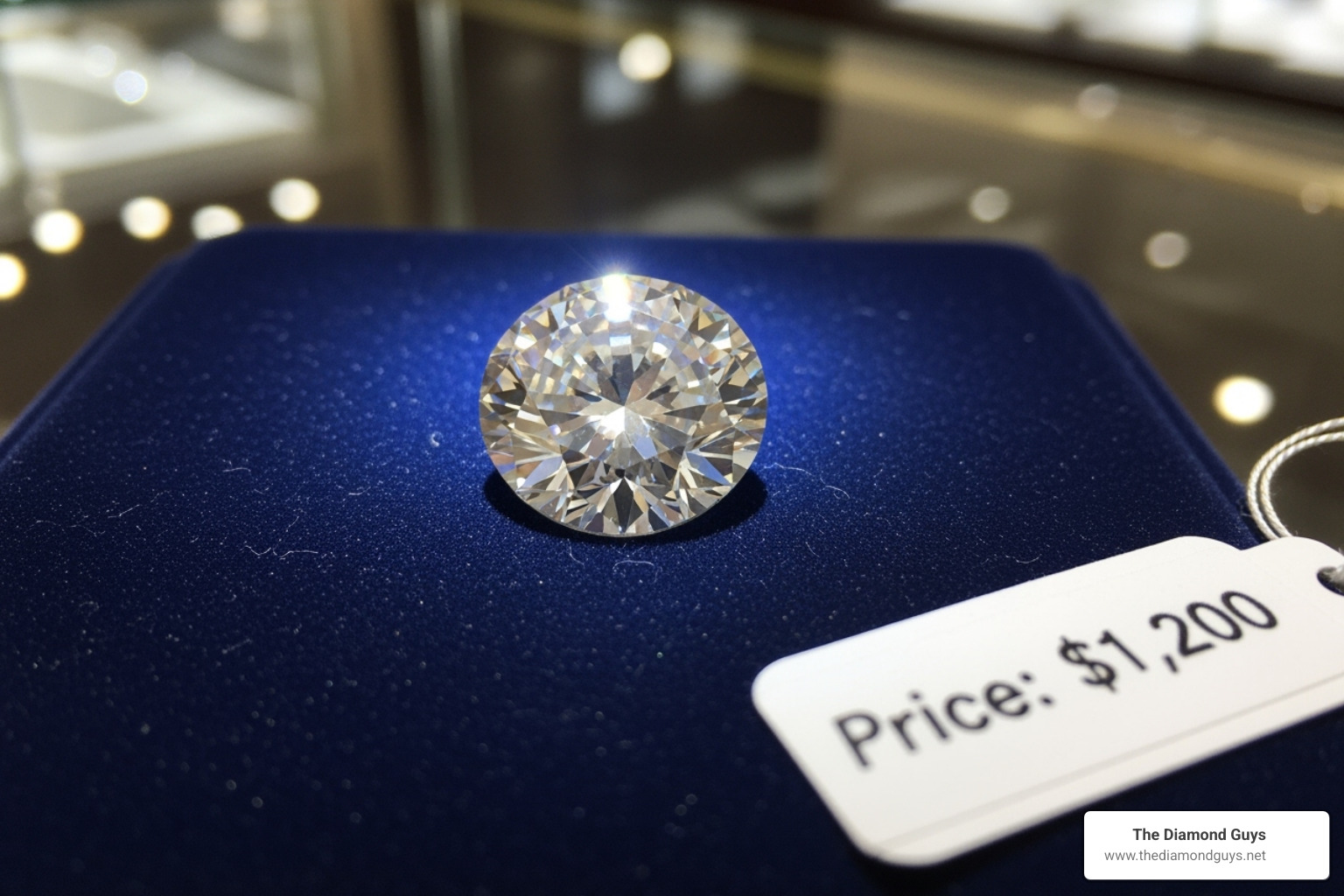
It's truly fascinating how a diamond's shape can make it appear bigger than its actual carat weight. For instance, an oval-cut diamond might seem larger than a round brilliant of the same weight because its elongated surface covers more finger real estate. This means you can often get a diamond that looks bigger for a lower synthetic diamond price just by choosing a fancy shape! Our personalized shopping experience at The Diamond Guys ensures we explore all these wonderful options with you, helping you choose a diamond that not only fits your budget but also perfectly captures your vision and style.
The Value Equation: Resale, Investment, and Future Trends
When you're thinking about the synthetic diamond price, it's smart to look beyond just the initial cost. It’s important to understand what happens to their value over time. This means we'll chat about things like resale value, whether they're an "investment," and what we expect to see in prices down the road.
Resale Value and Investment Potential
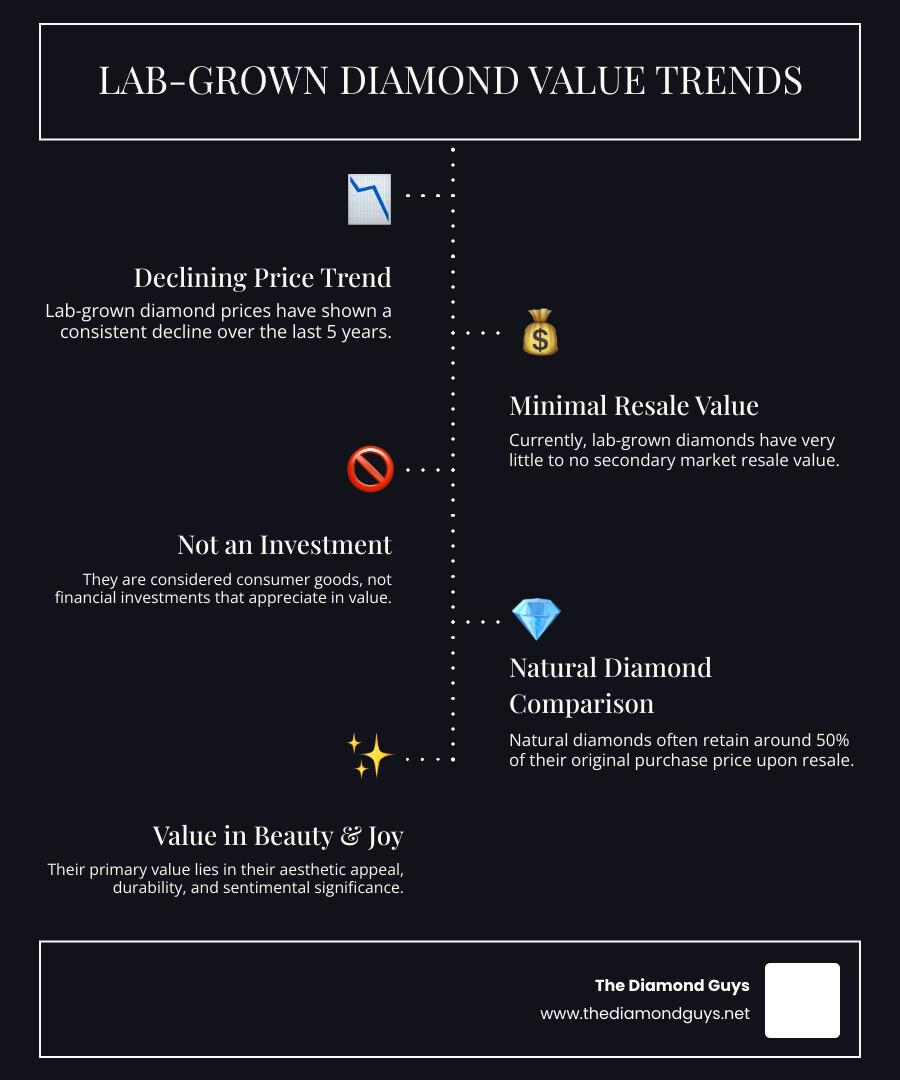
Let’s be honest and straightforward here: lab-grown diamonds currently have very little to no resale value. This is a big difference compared to natural diamonds. Natural diamonds have a long-standing secondary market. While their value can change, they often keep around 50% of their original purchase price.
Lab-grown diamonds are more like consumer goods, such as a new car or TV. Their value is in their beauty and durability, not as a financial investment that grows in worth. For instance, a lab-grown diamond bought for $1,200 might only resell for $50 or less.
So, if you're asking if lab-grown diamonds are a good financial investment, the answer is no. They won't make you money like a stock or a piece of real estate might. They are designed to be stunning, affordable choices for personal wear and deep sentimental meaning. For those who prioritize a potential future financial return, natural diamonds are still the main topic of conversation.
But don't let this discourage you! For many, being able to get a much larger or higher-quality diamond for their budget is a huge win. The lack of resale value often doesn't matter as much. After all, an engagement ring is first and foremost a beautiful symbol of love and commitment. It’s not meant to be something you trade for profit. If you’re curious about protecting your diamond, whether it's natural or lab-grown, you might want to read about Can You Insure a Lab-Grown Diamond.
Historical and Future Synthetic Diamond Price Trends
The synthetic diamond price has seen rapid drops in recent years. According to a Bain & Company report, the price of lab-created diamonds was cut in half in just two years. Some reports show a 30% drop for identical stones in only one year, highlighting the significant market changes.
This downward trend is tied directly to falling production costs. The cost to produce a one-carat lab-grown diamond has plummeted from about $4,000 in 2008 to just $300 to $500 per carat today. As technology improves and competition increases, prices are expected to continue falling until they reach a production cost floor.
What we’re seeing is that lab-grown diamonds are becoming more like everyday manufactured goods. When something can be made easily and by many different producers, its price tends to fall because of competition and efficiency. This is very different from the natural diamond market. Natural diamonds have a 50-year history of pretty stable prices, or even increases, because they are a limited resource.
Will lab-grown diamond prices keep falling forever? Experts believe they will eventually level out. There's a minimum cost involved in growing, cutting, polishing, and shipping a diamond. Once that cost is reached, prices should become more stable. However, exactly when and at what level this will happen isn’t clear, as new innovations are always popping up. You can find more detailed reports on these price changes, like this one about lab-created diamond prices going down.
The worldwide market for lab-grown diamonds is expected to reach nearly $30 billion by 2025. This growth shows that even as prices have dropped, more and more people are choosing them. It really highlights how much consumers want beautiful, affordable options to natural diamonds.
Beyond the Price Tag: Practical & Ethical Considerations
While the appealing synthetic diamond price is a huge draw, there's so much more to consider when choosing your perfect stone. It's not just about the numbers; it's about understanding the quality, ensuring authenticity, and aligning your choice with your personal values. You want a diamond that feels right, inside and out.
When you're making such a significant purchase, look at aspects like how a diamond's quality is verified, and what its journey means for our world.
Certification and Quality Assurance
No matter where a diamond comes from, its quality is always measured by the familiar "Four Cs" – Cut, Color, Clarity, and Carat. For both lab-grown and natural diamonds, getting a reputable grading certificate is absolutely essential. Think of this document as your diamond's official passport, giving you an unbiased and detailed evaluation of its unique characteristics. It’s your peace of mind.
When it comes to independent laboratories that grade diamonds, the Gemological Institute of America (GIA) and the International Gemological Institute (IGI) are the big names. While GIA is often seen as the gold standard for natural diamonds, IGI has truly become the leading authority for lab-grown diamonds. They provide comprehensive reports that break down your diamond's specific cut, color, clarity, and carat weight. This transparency builds confidence and helps you understand exactly what you're getting.
At The Diamond Guys in Scottsdale, AZ, and Los Angeles, CA, we prioritize IGI-certified stones for our clients' lab-grown diamonds. This ensures independently verified quality. These reports often specify the growth method (HPHT or CVD) and note the tiny laser inscription on the diamond's edge that confirms it's lab-grown, offering complete reassurance. To dive deeper into IGI's standards, visit their official website.
Ethical and Environmental Factors
Beyond the budget-friendly synthetic diamond price and dazzling beauty, many people choose lab-grown diamonds for their ethical and environmental benefits. It’s about making a choice you can truly feel good about.
Ethical Sourcing: You might have heard the term "blood diamonds" or "conflict diamonds." These are diamonds mined in war zones, tragically used to fund conflicts and human rights abuses. While the diamond industry has worked hard to improve ethical sourcing through initiatives like the Kimberley Process, which was established in 2003, some consumers simply prefer the absolute peace of mind that lab-grown diamonds offer. Because they are created in controlled laboratory environments, lab-grown diamonds provide guaranteed transparency of origin – they are, by their very nature, conflict-free.
Environmental Impact: This topic is nuanced. Diamond mining involves significant land disturbance and resource use. Lab-grown diamond production is also energy-intensive, but many producers are investing in renewable energy to shrink their carbon footprint. While both options have environmental considerations, proponents argue the contained energy use in a lab can have a smaller overall impact than mining. The "greener" choice often depends on the producer's specific practices.
One thing is for sure: lab-grown diamonds are incredibly practical in terms of durability. They are just as strong and resilient as their natural counterparts. They share the exact same Mohs hardness of 10, making them the hardest known substance – perfect for enduring everyday wear in an engagement ring or any other cherished piece of jewelry. For more on their impressive strength, you can read our guide: Are Lab-Grown Diamonds as Strong as Real Diamonds.
Frequently Asked Questions about Lab-Grown Diamond Prices
It's completely normal to have questions when you're exploring lab-grown diamonds, especially concerning their price and how they compare to natural stones. Our clients often ask us some really smart questions, and we're always happy to clear things up. Here are some of the most common ones we hear:
Do lab-grown diamonds test as real diamonds?
This is a fantastic question, and the answer is a resounding "Yes, absolutely!" Think of it this way: a lab-grown diamond is chemically, physically, and optically identical to a natural diamond. They are both made of crystallized carbon, sharing the exact same sparkle, fire, and incredible durability.
Because they are so fundamentally alike, any standard diamond tester you'd encounter will confirm a lab-grown diamond is, indeed, a real diamond. These testers usually check for things like thermal or electrical conductivity, properties that are inherent to carbon in diamond form. So, whether it came from deep within the earth or a high-tech lab, it will register as a "real" diamond on the equipment. It's truly amazing how science can replicate nature's artistry! If you're curious to dive deeper into how these tests work, we've got a detailed article on it: Do Lab-Grown Diamonds Pass a Diamond Tester.
Can jewelers tell the difference between lab-grown and natural diamonds?
To the everyday eye, and even to the trained eye without specialized tools, it's virtually impossible to tell the difference between a lab-grown diamond and a natural diamond. They simply look identical. They sparkle the same way, reflect light with the same brilliance, and feel the same to the touch. This is why the synthetic diamond price offers such incredible value – you get the same beauty for less!
However, for a trained gemologist, it's a different story. At The Diamond Guys, our experts use specialized equipment that can detect tiny, subtle differences in how the diamonds grew. These might be microscopic growth patterns or unique trace elements that reveal their origin. These distinctions are invisible to the naked eye, even for someone with a lot of experience.
Transparency is key in our business. Any reputable jeweler will always tell you whether a diamond is lab-grown or natural. Plus, many lab-grown diamonds come with a tiny, microscopic laser inscription on their girdle (that thin edge around the diamond). This inscription, usually only visible under high magnification, clearly identifies it as lab-grown, giving you complete peace of mind. Want to know more about how jewelers distinguish them? Check out our article: Can Jewelers Tell the Difference Between Lab-Grown Diamonds.
Conclusion: Getting the Best Value for Your Budget
So, after diving deep into lab-grown diamonds, what's the big takeaway? Understanding the synthetic diamond price really opens up a fantastic opportunity. It shows us a modern, exciting choice for anyone looking for that perfect sparkle.
Lab-grown diamonds truly offer incredible value. You can get a much larger, higher-quality stone for a fraction of what a natural diamond would cost. Think about it: the same dazzling brilliance, the same amazing durability, all without breaking the bank. They are, in every chemical and physical way, identical to diamonds pulled from the earth.
Now, we've talked about it: the main difference is that lab-grown diamonds have very little to no resale value. They are more like a beautiful consumer good than a financial investment. But for many, the sentimental value of an engagement ring far, far outweighs any thought of monetary return. After all, this is a symbol of love and commitment, not a stock certificate! The falling synthetic diamond price means you can truly get more "wow" factor for your budget. You can choose a bigger stone or a higher quality one, making your dream ring a reality.
The choice between a lab-grown and a natural diamond comes down to your personal preferences, your priorities, and, of course, your budget. If your main goal is to get the biggest, most beautiful diamond possible within your spending limit, and you're not worried about it being a financial investment, then a lab-grown diamond is an absolutely brilliant choice. If, however, you're drawn to the idea of a rare, ancient jewel with a history of value retention, then a natural diamond might be a better fit for you. Both are wonderful options!
At The Diamond Guys, we're here to help you steer this exciting decision. Whether you're in Scottsdale, AZ, or Los Angeles, CA, we offer expert guidance and a truly personalized shopping experience. Our goal is to make sure you're fully informed and confident in your choice. We'll walk you through the Four Cs, show you different shapes, and explain all the factors that impact diamond pricing. Our aim is to help you find that perfect symbol of your love, one that you'll cherish forever.
Ready to explore all the possibilities? We invite you to dive even deeper into the details with our comprehensive guide: Explore the differences further with our complete guide to Lab Diamonds vs. Real Diamonds.


